
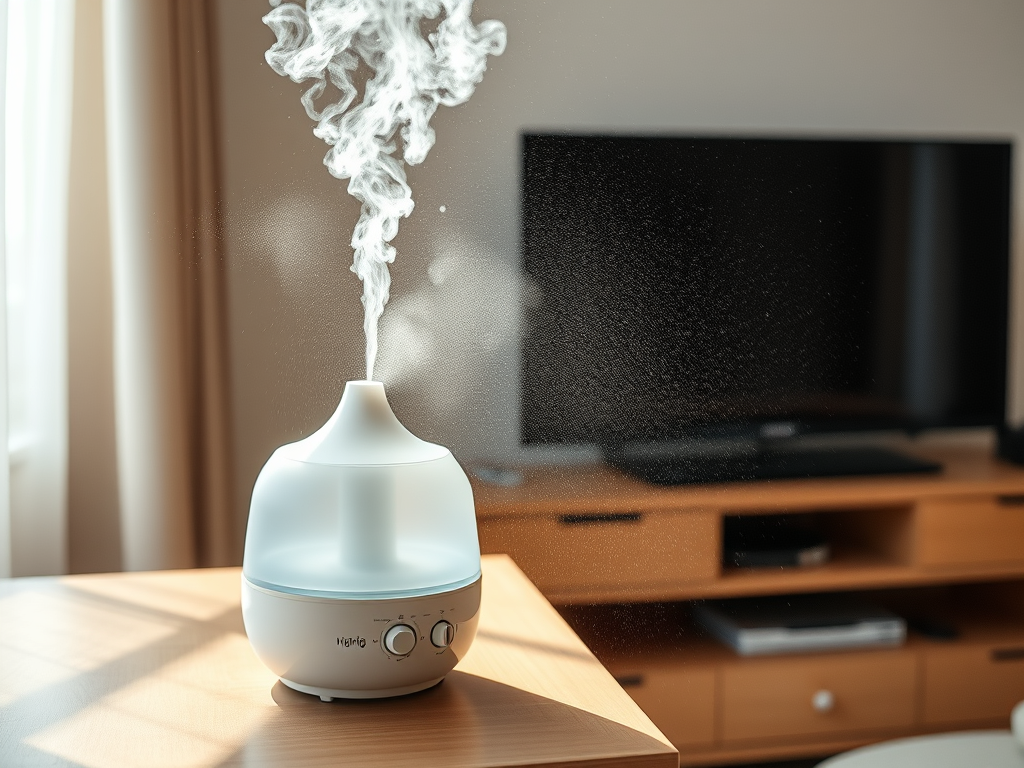
If you have ever run a humidifier overnight and woke up to a faint chalky film on your dresser, nightstand, TV screen, or windows, you have met humidifier white dust. It is not mysterious. It is not “dirty air.” It is usually just your water, turning into tiny particles and settling on your home.
Here is what white dust is, why it happens, and why switching to distilled water is the simplest way to stop it.
What “White Dust” Actually Is
White dust is mineral residue. Most tap and many filtered waters still contain dissolved minerals, mainly calcium and magnesium (the stuff that makes water “hard”). Those minerals are invisible while dissolved in water. The moment the water gets turned into a mist and the water part evaporates, the minerals have nowhere to go, so they become fine particles that float, then settle as powder.
Common signs you are dealing with mineral dust:
- A light white film on furniture near the humidifier
- Chalky buildup on the humidifier base, tank, or ultrasonic plate
- More dust showing up in a room that otherwise stays pretty clean
- A visible haze if sunlight hits the mist at the right angle
Why It Happens More With Certain Humidifiers
Ultrasonic humidifiers are the main culprit
Ultrasonic units use high frequency vibration to break water into a fine mist. They do not boil the water or remove minerals. They simply aerosolize whatever is in the tank, including dissolved minerals. That is why ultrasonic humidifiers are famous for white dust when used with mineral containing water.
Warm mist units tend to create less white dust
Warm mist (steam) humidifiers boil water and release steam. Minerals usually stay behind as scale in the unit instead of floating into the air, though you will still have to descale and clean the machine.
Evaporative humidifiers often reduce white dust, but do not eliminate the mineral problem
Evaporative units use a wick filter and a fan. The wick can trap some minerals, but that means you will replace filters more often and still fight mineral buildup over time.
Why Filtered Water Usually Does Not Fix It
This is the part that annoys people because it sounds like it should work.
Most common filters improve taste and odor by reducing chlorine and some contaminants. They typically do not remove dissolved minerals in a meaningful way. Even some “purified” waters still contain mineral content, either naturally or added back for taste.
So you can be doing everything “right” and still be feeding your humidifier the exact ingredients that become white dust.
Why Distilled Water Fixes It
Distilled water is water with the minerals removed. Distillation works by turning water into vapor and then condensing it back into liquid. Minerals do not evaporate with the water, so they are left behind. That means:
- Less or no white dust because there is little mineral content to aerosolize
- Less scale and crust inside the humidifier
- Less frequent deep cleaning and descaling
- Better consistency, especially in ultrasonic units
Think of it like this: white dust is a mineral delivery system. Remove the minerals and you remove the dust.
Other Reasons You Might Still See Dust
If you switch to distilled and you still see dust, it is usually one of these:
- Old residue: Minerals already on surfaces can get stirred up by airflow. Wipe down once, then reassess after a few days.
- Room dust, not white dust: Regular household dust is gray or tan. White mineral dust is brighter and powdery.
- Humidifier needs cleaning: If the base already has mineral scale, run a proper cleaning cycle so you are not re-dispersing old buildup.
- Water was not truly distilled: Double check the label. “Spring,” “purified,” and “drinking water” are not the same thing.
How to Reduce White Dust Immediately
If you want a quick checklist:
- Use distilled water in ultrasonic humidifiers
- Clean the unit weekly (more often if you previously used hard water)
- Empty the tank daily and let it dry when not in use
- Keep the humidifier on a stable surface and a bit away from walls
- Use the lowest mist setting that keeps you comfortable
Quick Cleaning Note (So You Do Not Trap Minerals Forever)
Even if you switch to distilled today, it is worth cleaning out the old mineral scale so the machine runs clean.
A common approach is to follow your manufacturer’s cleaning instructions. Many recommend a mild acid like white vinegar for descaling, followed by thorough rinsing. Avoid mixing cleaning chemicals, and never run anything through the unit that your manual does not allow.
Bottom Line
Humidifier white dust is usually just minerals from your water becoming airborne. Ultrasonic humidifiers make it obvious because they atomize everything in the tank. Filtered water often leaves enough minerals behind to keep the problem going. Distilled removes the minerals, so the dust has nothing to form from.
If you want the simplest fix, switch the water, not the machine.
Grab distilled for your humidifier here: https://distilledfulfilled.com/shop/
FAQ
Is white dust dangerous?
It is typically mineral residue (like calcium and magnesium). Many people mainly find it annoying because it coats surfaces. If you have respiratory sensitivities, reducing airborne particulates is a good idea, and distilled water is the easiest way to minimize humidifier mineral aerosols.
Can I just use “purified” bottled water?
Sometimes it helps, sometimes it does not. Many purified waters still contain dissolved minerals. Distilled is the most reliable option for preventing mineral dust.
Do humidifier “demineralization cartridges” work?
They can reduce minerals, but they vary widely by brand and water hardness, and they need replacement. Distilled is usually simpler and more consistent.
Why does the dust show up more in one room than another?
Room size, airflow, placement, and how close surfaces are to the mist all matter. A small room with an ultrasonic humidifier running high will show dust faster than a larger, well-ventilated space.
Leave a Reply