
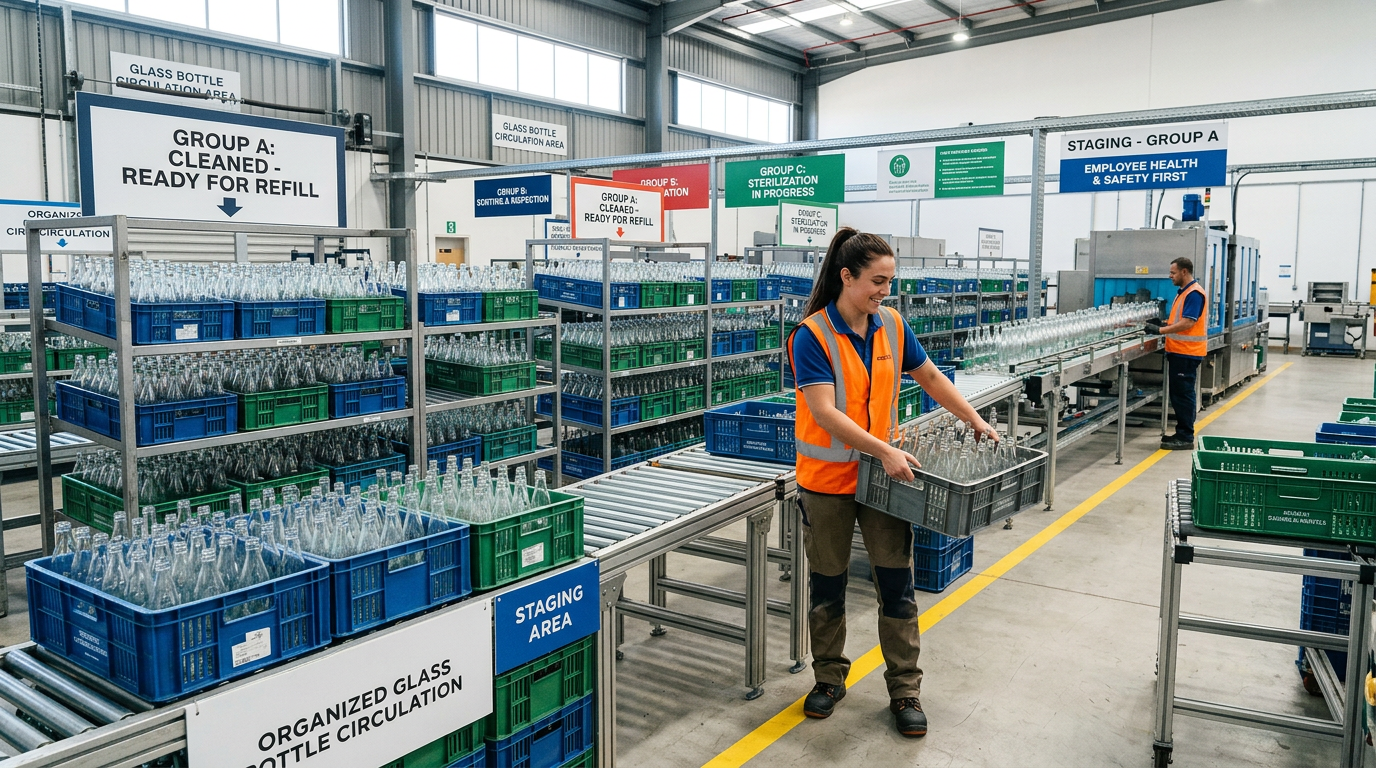
At first glance, a glass-bottle refill business can look like a simple counting exercise. Buy a lot of bottles, fill them with water, and keep going. In reality, that is only the static version of the story. The real business is motion. Durable glass works best when bottles keep moving through a repeatable loop: use, return, inspection, professional cleaning, refill, and redistribution.
That distinction matters because “having bottles” and “having bottles available to serve customers today” are not the same thing. A bottle sitting in a garage, under a desk, or waiting in the back of a car is still part of total inventory, but it is not active inventory. It cannot be cleaned, filled, and sent back out until it returns to the system. For a company delivering distilled water in reusable glass, circulation is the operating heartbeat.
That is especially true for premium distilled water, which people often choose because it is a clean, low-mineral, neutral baseline for drinking and everyday household use. The water may be simple, but the bottle system behind it is not. The quality customers experience depends not just on what goes into the bottle, but on how reliably the bottle comes back, gets inspected, gets cleaned, and returns to service.
So if you want to understand why a reusable-glass delivery model works when it works, do not start by asking, “How many bottles are there?” Start by asking, “How well do they circulate?” That one shift explains a surprising amount about convenience, consistency, service reliability, and why some refill systems feel smooth while others feel like a scavenger hunt with better hydration.
Inventory Is a Count. Circulation Is a System.
Traditional inventory thinking focuses on quantity. If a business owns enough units, it should be able to meet demand. That logic works reasonably well for disposable packaging because each container has a one-way job. It gets filled, sold, used, and discarded or recycled elsewhere. The business moves forward by buying more containers.
Reusable glass is different. The same bottle is expected to perform again and again. That means the bottle is not just packaging; it is a working asset. Its value depends on how consistently it completes the loop and comes back ready for another cycle.
In practice, a refill company is balancing several categories at once:
- Bottles currently filled and ready for delivery
- Bottles in customer homes or workplaces being actively used
- Empties waiting to be returned
- Returned bottles awaiting inspection and professional cleaning
- Bottles temporarily out of service due to damage, chips, cracks, or heavy wear
- Bottles lost, broken, or otherwise no longer usable
Only part of that total inventory is truly available at any given moment. That is why a refill business lives or dies by circulation rhythm. A large pile of bottles does not help much if too many of them are stalled outside the operating loop.
What “Active Inventory” Really Means
Active inventory is the share of bottles that can realistically support current service. These are the bottles moving through the cycle at a healthy pace, not stranded in a kind of domestic witness protection program behind the holiday decorations.
For reusable glass, active inventory is shaped by timing as much as quantity. Even durable bottles spend a lot of time away from the refill facility. A customer may keep one on the counter, one in the pantry, and one half-finished in the refrigerator. An office may use bottles steadily but return empties only on a scheduled day. A household might mean to set out returns, then forget for a week. None of this is unusual. It is simply part of the real-world rhythm of reusable packaging.
From an operations standpoint, that means customer demand and bottle availability are linked, but not perfectly synchronized. People may be ready for fresh distilled water before all their empties make it back. A refill company needs enough active circulation to absorb those small delays without the whole system getting tight.
This is one reason a reusable-glass service can feel more sophisticated than it looks. Behind the simplicity of a filled bottle at your door is a constant timing puzzle: keeping enough clean, inspected, ready-to-fill glass in motion while some portion of the fleet is always out in the world being useful.
The Loop That Keeps the Business Running
A healthy circulation model depends on a repeatable chain of custody. The basic loop sounds simple, but each step matters:
- Customers use the water.
- Empty bottles are returned.
- Bottles are inspected for condition and suitability for reuse.
- Approved bottles are professionally cleaned and prepared.
- Bottles are refilled.
- Filled bottles are redistributed for the next round.
If one stage slows down, the entire system feels it. Returns lag, and fewer bottles are available for cleaning. Cleaning backs up, and fewer bottles are ready for refill. Refill slows, and distribution has less ready stock. This is why circulation is not a nice extra. It is the mechanism that turns glass from a beautiful object into a reliable delivery format.
That reliability is part of the appeal. Customers who prefer reusable glass generally want a routine that feels clean, practical, and consistent. They do not want to wonder whether the system has enough ready bottles this week. Good circulation supports that calm, boring reliability, which in delivery logistics is high praise.
If you are looking for a straightforward way to make that routine easier at home or at work, you can shop Distilled Fulfilled’s distilled water in reusable glass bottles and build around a refill rhythm that makes returns part of the normal flow, not an afterthought.
Bottles Sitting at Home Are Not “Bad,” But They Are Not Working
It is worth saying clearly: bottles in customer homes are not a problem in themselves. That is where they are supposed to be used. A reusable-glass business exists so customers can actually enjoy the product, not so every bottle can remain in a warehouse lined up like a very hydrated marching band.
The challenge is duration. The longer empties sit before returning, the longer they remain unavailable for the next cycle. If enough bottles linger outside the return stream, the system needs more total inventory just to maintain the same level of service. In other words, slower circulation quietly increases operational strain.
This is why return habits matter so much. The business is not only delivering water; it is coordinating a reusable container ecosystem spread across many homes and workplaces, each with its own habits, schedules, and storage quirks. Some customers rotate empties promptly. Others let them accumulate. Some have a predictable delivery cadence. Others use more water one week and less the next.
None of that is wrong. It simply means that circulation depends on cooperation between service design and customer routine. The easier the return process, the healthier the bottle loop tends to be.
Why Breakage Matters Even with Durable Glass
Durable glass is durable, not indestructible. That distinction is important. In a reusable system, some bottles will eventually leave circulation due to chips, cracks, impact damage, or general wear that makes them unsuitable for continued use. That is normal for any long-lived container fleet.
Breakage matters because every bottle removed from service reduces active capacity until it is replaced. The business is not just managing a reusable asset; it is managing attrition within that asset base. A bottle can only keep contributing if it returns in reusable condition.
This is also where practical expectations help. Reusable glass can be an excellent option for home and many workplace routines, but there are situations where glass may be unsafe, impractical, or prohibited. Certain venues, travel contexts, events, outdoor settings, or regulated environments may call for different packaging. The point is not to force glass into every situation. The point is to use it where it works well and to handle it with the ordinary care a durable reusable material deserves.
For customers, that usually means simple habits:
- Store bottles where they are less likely to be knocked over
- Return empties in a stable, designated spot
- Avoid using damaged bottles
- Follow any product directions or service guidance that comes with your delivery
And for any equipment, appliance, food-service, or other safety-sensitive use of distilled water, follow manufacturer instructions and relevant official or professional guidance. Distilled water is a practical low-mineral option in many contexts, but the right use still depends on the product or application.
Return Rhythm Is What Makes Convenience Real
People often think convenience comes mainly from delivery, but in reusable systems, convenience is just as much about return rhythm. A bottle service feels easy when the handoff is predictable: full bottles arrive, empties leave, and nobody has to think too hard about what happens next.
That predictability does several useful things at once. It keeps active inventory moving. It reduces the chance of bottle pileups in customer spaces. It helps a refill company plan cleaning and refill schedules. And it makes the whole service feel less like a special project and more like part of ordinary household management.
That is one of the underrated strengths of a well-run reusable-glass model. It can turn something that sounds operationally complicated into something that feels refreshingly routine. Customers do not need to master logistics. They just need a system they can participate in consistently.
For many people, that is the sweet spot: premium distilled water in reusable glass, without turning hydration into a hobby with spreadsheets.
Why Circulation Supports Quality Control
Circulation is not only about keeping enough bottles available. It also supports quality control. When bottles return regularly, they can be inspected, professionally cleaned, and evaluated before reentering service. A stalled bottle sitting out of the loop cannot benefit from that process until it comes back.
That return-and-review cycle is part of what makes reusable packaging operationally different from single-use packaging. The bottle is not simply consumed and forgotten. It reappears for assessment. That gives the refill model a recurring checkpoint where condition matters.
For customers, the practical takeaway is straightforward: regular returns help keep the whole system cleaner, steadier, and more dependable. You are not just clearing counter space. You are helping move the next round of service into place.
If that kind of reusable routine appeals to you, it is easy to start with the product itself and let the return habit follow naturally. You can shop Distilled Fulfilled’s distilled water in reusable glass bottles and make bottle circulation part of a simpler refill pattern rather than a once-in-a-while scramble.
The Difference Between Buffer Inventory and Lazy Inventory
Every refill business needs some breathing room. Not every bottle can be in immediate circulation at every moment, and some reserve capacity is practical. A buffer helps absorb delays, seasonal fluctuations, route changes, and the ordinary fact that real life rarely keeps perfect time.
But there is a difference between healthy buffer inventory and lazy inventory. Healthy buffer inventory exists to support service continuity. Lazy inventory is inventory that has effectively gone to sleep in the system: bottles not returning promptly, bottles trapped in cluttered storage, bottles sidelined by damage, or bottles otherwise unavailable for productive reuse.
This is why the best metric is not simply “more bottles.” More bottles may help, but only if they are part of a returnable, inspectable, refillable flow. A reusable-glass business grows stronger when it improves circulation quality, not merely when it accumulates more glass.
What Customers Can Do to Help the Loop Work Better
Customers do not need to think like operations managers, but a few small habits make a real difference in any refill model:
- Keep empties together in a consistent return spot
- Set out returns on the expected service schedule
- Handle bottles carefully and avoid using any that appear damaged
- Order in a way that matches your real usage pattern as closely as possible
- Treat the service as a routine, not a random restock event
These are simple behaviors, but they support the entire loop. They help convert total inventory into active inventory. They reduce delays between use and return. And they make reusable glass more convenient for everyone involved.
That is also where a company like Distilled Fulfilled fits naturally. The appeal is not just the bottle, and not just the water. It is the combination of premium distilled water and a reusable-glass routine that feels practical enough to keep doing. The more repeatable the routine, the better the circulation. The better the circulation, the more reliable the service.
Why This Matters More Than It Seems
On paper, bottle circulation can sound like back-end logistics. In real life, it shapes the customer experience. It affects whether deliveries feel dependable, whether returns feel easy, and whether reusable glass remains a practical option rather than a charming idea with scheduling issues.
It also explains why refill businesses talk so much about systems, even when customers mostly see the finished product. The visible part is a filled bottle of distilled water. The invisible part is a circulation loop that has to keep functioning day after day.
That loop is the business. The glass is the tool. And the routine is what turns both into a service people can rely on.
If you want that kind of steady, reusable-glass rhythm in your own household or workspace, a good next step is to shop Distilled Fulfilled’s distilled water in reusable glass bottles and make reusable glass bottles or glass jugs part of the way you regularly stock clean, low-mineral water.
Final Sip
A glass refill business does not succeed just because it owns bottles. It succeeds when bottles keep circulating through use, return, inspection, professional cleaning, refill, and redistribution. Active inventory is what keeps service moving; bottles stalled in homes, delayed in return, or removed by breakage are still part of the story, but not the part that powers the next delivery.
That is why reusable glass works best as a routine, not a one-off purchase. Distilled Fulfilled’s model makes the most sense when the bottles keep coming back, getting refreshed, and heading out again, turning premium distilled water in reusable glass bottles or glass jugs into a practical part of everyday life.
Leave a Reply