
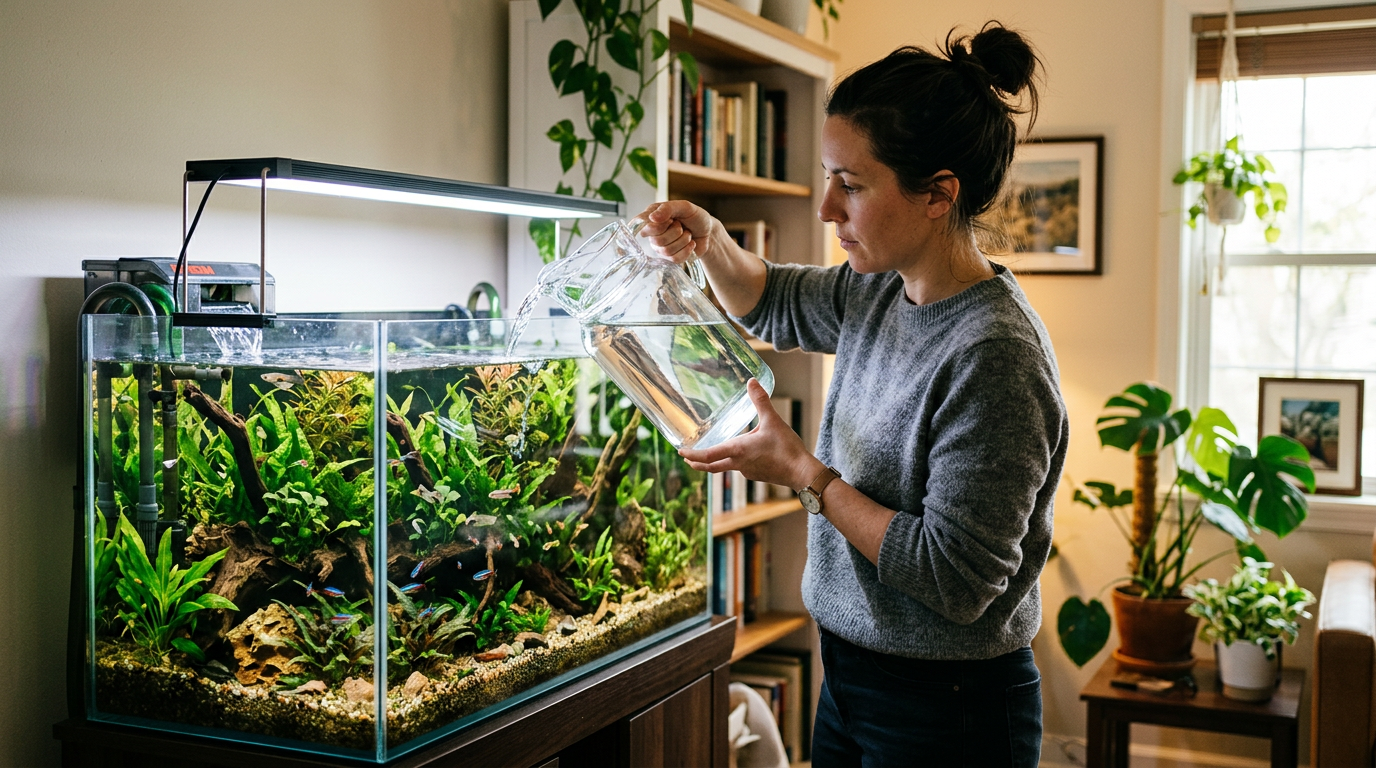
If you keep an aquarium long enough, you learn that “adding water” can mean two very different things. One is topping off for evaporation. The other is doing a water change. They may look similar from across the room, but inside the tank they accomplish completely different jobs.
That difference matters because when water evaporates, the water itself leaves the tank while minerals, salts, and many dissolved substances generally stay behind. In other words, the tank gets lower, but it does not get cleaner. A top-off restores lost water volume. A water change removes some old water and replaces it with new water to help manage waste, dissolved buildup, and overall water chemistry.
This is where low-mineral water often enters the conversation. Distilled water is a clean, low-mineral baseline, so many aquarists use it for evaporation top-offs where that approach fits their tank and species. But “often used” is not the same as “always right.” Freshwater planted tanks, reef systems, shrimp setups, and species with narrow parameter needs all have their own rules, and no single water source is a universal answer.
The practical goal is simple: understand what evaporation changes, understand what a water change changes, test your water, and follow species-specific aquarium guidance. And one point is worth stating plainly at the start: distilled water should not be treated as a one-size-fits-all habitat water, and you should never assume fish can live in straight distilled water without appropriate remineralization and tank-specific planning.
What Evaporation Actually Does to Aquarium Water
When water evaporates from an aquarium, only the water molecules leave as vapor. The dissolved minerals and salts generally remain behind in the tank. That means the water level drops, but the concentration of many dissolved substances can rise as the same amount of dissolved material is now suspended in less water.
In a freshwater aquarium, that may affect hardness, alkalinity, and total dissolved solids over time. In a saltwater aquarium, evaporation can increase salinity if the lost water is not replaced correctly. Either way, the problem is not just that the tank looks low. The chemistry can drift if evaporation is ignored or if top-offs are done with water that adds still more minerals to the system.
This is why experienced aquarists separate the idea of “replacing what evaporated” from “refreshing the tank.” One restores volume. The other helps reset conditions by removing some existing water and replacing it according to the needs of the aquarium.
Why a Top-Off Is Not a Water Change
A top-off replaces only the water that has left through evaporation. Because the minerals and salts generally stayed behind, the top-off water is often chosen specifically to avoid adding more dissolved material. In many compatible setups, that is why low-mineral water such as distilled water is used for topping off.
A water change does something different. You physically remove a portion of aquarium water that contains dissolved waste, organics, excess nutrients, and other accumulated substances, then replace it with appropriately prepared new water. A water change can help manage nitrate, replenish or rebalance certain parameters depending on the system, and improve overall water quality. A top-off cannot do that, no matter how pristine the replacement water is.
Put another way, pouring water back into a tank after evaporation is like refilling a pot that simmered on the stove. You get the level back up, but you did not dump out what was concentrated in the pot. A water change is the step where you actually remove old water and replace it.
Why Distilled Water Is Often Used for Top-Offs
Distilled water is valued in many aquarium routines because it starts as a low-mineral, neutral baseline. If evaporation leaves minerals behind, using high-mineral replacement water for every top-off can gradually push hardness or dissolved solids upward. Using distilled water for top-offs, where compatible with the aquarium, helps replace the lost water without continually adding extra mineral content.
That can be especially useful in systems where stability matters and where your care plan already accounts for water chemistry through testing, mixing, remineralization, or other species-appropriate preparation. In saltwater aquariums, for example, evaporation top-offs are typically about replacing pure water loss, not adding more salt. In some freshwater systems, aquarists also prefer a low-mineral top-off source to reduce parameter creep.
Still, “low-mineral” does not mean “automatically correct.” Distilled water is a tool, not a shortcut. Aquarium inhabitants vary widely, and some setups depend on carefully maintained mineral content, buffering capacity, or target ranges developed around the species you keep. That is why the right question is not “Is distilled water good for aquariums?” but “Is distilled water appropriate for this tank, for this purpose, under this care plan?”
If you want a practical, consistent source for top-off water in compatible aquarium routines, you can shop Distilled Fulfilled’s distilled water in reusable glass bottles. It is a tidy option for people who want low-mineral water on hand without making every refill errand feel like a side quest.
Important Caution: Distilled Water Is Not a Universal Habitat Water
This is the part where aquarium advice can get sloppy online, so let’s keep it crisp. Distilled water should not be treated as a universal, ready-to-use habitat water for fish, shrimp, snails, corals, or plants. Many aquatic species need specific mineral content and stable parameters. Straight distilled water, used without appropriate remineralization or mixing where required, can be unsuitable for long-term habitat use.
That does not make distilled water “bad.” It means aquariums are chemistry-driven ecosystems, not houseplants with gills. Some hobbyists use distilled water as part of a broader water-preparation method. Others use it only for evaporation top-offs. Others skip it entirely because their species, source water, or management style call for a different approach. The right path depends on the animals, plants, and system you are keeping.
Always follow species-specific care guidance, aquarium product directions, and, when needed, veterinary or professional aquatic advice. If a care sheet, breeder, aquatic veterinarian, or manufacturer gives instructions for remineralization, salinity management, buffering, or mixing ratios, those directions take priority over generic internet enthusiasm.
What to Measure Before You Decide on a Top-Off Routine
If you are trying to decide whether distilled water makes sense for your aquarium top-offs, testing matters more than guessing. The exact parameters worth tracking will depend on your setup, but the big picture is straightforward: you want to know how evaporation and replacement water affect the chemistry your species depend on.
- Measure the parameters relevant to your tank, such as salinity for marine systems or other commonly tracked values recommended for your species and equipment.
- Test your source water so you know what you are adding during top-offs and water changes.
- Watch for trends over time, not just one-off readings. Slow drift is common in aquariums.
- Use the instructions on your test kits, controllers, and aquarium products.
- Adjust your routine based on reliable readings and species-specific guidance, not assumptions.
That last point is the quiet hero of fishkeeping. A tank can look clear, the fish can look cheerful, and the numbers can still be sliding in the wrong direction. Consistency usually beats improvisation, especially once you know how your tank behaves between maintenance days.
Top-Off Water vs. Water-Change Water
One easy way to stay organized is to think of aquarium water in two separate buckets, even if they do not exist as literal buckets. Top-off water is for replacing evaporation. Water-change water is for replacing removed aquarium water. Those two jobs may call for different preparation methods.
For top-offs, many aquarists use low-mineral water because evaporation generally leaves the minerals behind. For water changes, the replacement water needs to match the needs of the tank. Depending on the aquarium, that may involve conditioning tap water, mixing purified water with minerals, preparing saltwater correctly for marine systems, or following another tested routine.
Confusing the two can cause problems. If you top off with mineral-rich water in a tank that is already concentrating minerals through evaporation, you may gradually push parameters upward. If you treat water changes like simple top-offs, you may restore volume without addressing dissolved waste or accumulated compounds. Different task, different goal.
Common Mistakes Aquarists Make With Evaporation
Most aquarium errors are not dramatic disasters. They are small habits repeated over time. Evaporation management is a perfect example.
Using the same logic for every tank
A betta tank, a cichlid setup, a reef aquarium, and a shrimp breeding rack are not interchangeable chemistry projects. Water that works beautifully in one can be wrong in another.
Ignoring evaporation until the water line drops a lot
Large swings are usually harder on an aquarium than small, consistent corrections. A regular top-off routine can help keep conditions steadier.
Assuming a top-off counts as maintenance
It counts as one kind of maintenance. It does not replace partial water changes, filter care, testing, or the rest of your tank routine.
Adding water without testing trends
If you never check how your source water and top-off routine affect your actual tank parameters, you are working from vibes alone. Fishkeeping deserves better than vibes.
When Distilled Water Can Be a Practical Household Choice
Even outside the aquarium itself, a dependable supply of distilled water can make life easier for hobbyists who use it in compatible top-off routines. You do not need to hope the store shelf is stocked, and you do not need to juggle random containers every time the tank level drops. For many people, convenience is not a luxury feature; it is what makes consistency possible.
Distilled Fulfilled focuses on premium distilled water in reusable glass bottles and glass jugs, which fits nicely with households trying to keep a cleaner, more deliberate water routine. The brand’s “Stop Drinking Plastic” mindset is part of the appeal, but the aquarium-specific benefit here is practical: having low-mineral water available when your tested, species-appropriate maintenance plan calls for it.
If that sounds like the sort of routine you would actually stick with, you can shop Distilled Fulfilled’s distilled water in reusable glass bottles and keep top-off water ready to go. As always, glass is great when it fits the setting, though there are places and situations where glass may be unsafe, impractical, or not allowed.
A Simple Routine for Managing Evaporation Responsibly
You do not need a heroic spreadsheet to handle evaporation well, though no judgment if you enjoy one. A basic routine is enough for most home aquarists:
- Learn your tank’s normal evaporation pattern.
- Decide, based on testing and species-specific guidance, what kind of top-off water is appropriate for your setup.
- Keep top-off water separate in your mind from water-change water.
- Test the parameters relevant to your aquarium on a consistent schedule.
- Perform regular water changes according to the needs of the tank, not just when the level looks low.
- Revisit your routine if livestock, plants, feeding, filtration, season, or room temperature changes.
This kind of approach is less flashy than miracle solutions, but it works. Aquariums tend to reward boring competence. Your fish will not send a thank-you note, but stable water is close enough.
Species-Specific Guidance Matters More Than General Advice
It is tempting to hunt for one universal rule about distilled water and aquariums, but the hobby simply does not work that way. Soft-water species, hard-water species, planted aquariums, marine tanks, and sensitive invertebrates all have different needs. Even within a category, one keeper’s method may not translate cleanly to your setup because stocking, substrate, filtration, feeding, and source water can all change the picture.
That is why the safest and smartest path is to treat general advice as a starting point, then confirm your plan with species-specific care guidance, trusted aquatic professionals when needed, and the directions for the products you use. Distilled water can be extremely useful in the right context, especially for evaporation top-offs, but it is still only one part of a sound maintenance strategy.
Final Sip
Evaporation top-offs and water changes are not interchangeable. Evaporation removes water while minerals and salts generally remain behind, so top-offs restore volume, while water changes remove old water and help manage buildup. In many compatible aquarium routines, distilled water works well for top-offs because it is a low-mineral baseline, but it is not a universal habitat water and should never replace species-specific planning, testing, and appropriate remineralization where required.
If your aquarium routine calls for a dependable source of distilled water, Distilled Fulfilled can make that part simpler with reusable glass bottles and glass jugs. Keep the chemistry decisions grounded in testing and care guidance, then make shop Distilled Fulfilled’s distilled water in reusable glass bottles part of a steady, practical top-off routine that works for your tank and your household.
Leave a Reply