
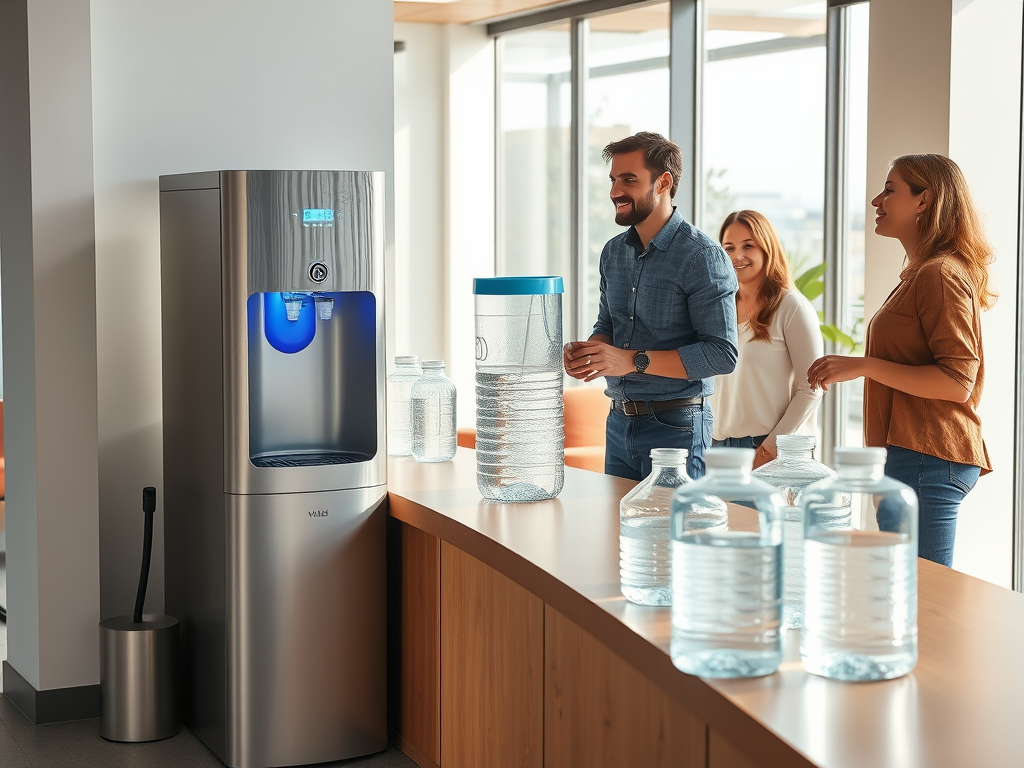
If you have ever sat through a meeting where someone quietly whispers, “Do not drink the sink water,” you already understand the truth about office water: people notice it, they just do not put it on a ticket.
When an office upgrades water (filtered stations, a bottleless cooler, or scheduled delivery in glass), employees rarely say, “Wow, the mineral profile is exceptional.” What they say is simpler:
- “This actually tastes good.”
- “I am drinking more water without thinking about it.”
- “Coffee tastes better here now.”
- “The bottle filler is always cold and fast.”
- “We stopped running out.”
Those are the signals that matter. This post breaks down what people really notice, why it happens, and how to make sure your upgrade feels like an upgrade instead of a new piece of office furniture nobody uses.
What Employees Notice First (Week 1)
1) Taste and smell, immediately
Most office complaints about water are not about safety. They are about experience: chlorine smell, metallic notes, “pool” vibes, or that stale taste from warm pipes. These are often tied to aesthetic water quality factors like odor and total dissolved solids (TDS), which regulators treat as secondary (non health) standards because they influence acceptability more than safety. EPA secondary drinking water standards list odor guidance and a TDS secondary standard of 500 mg/L. EPA overview
When you switch to better water, people stop making faces. They stop adding lemon to hide the taste. They refill more often.
2) Temperature and speed
Cold water and a fast fill rate are underrated. If the station is slow, people bail. If it is lukewarm, they bail. A good setup makes refilling feel effortless and quick, which is the whole game.
3) “Where is it?” matters more than “what is it?”
If your best water is hidden in the break room behind the fridge, it becomes “nice to have.” If it is placed near traffic (entry, kitchen, central hallway), it becomes a habit.
What Changes Next (Weeks 2 to 4)
4) People drink more, and they feel it
Mild dehydration has been linked in research to changes in mood and cognitive performance, including attention and immediate memory. Review on dehydration and cognitive performance (Adan, 2012) A large review also summarizes evidence that dehydration can impair mood and cognition, and that rehydration can help. Effects of dehydration and rehydration on cognitive performance (Zhang et al., 2019)
In office terms, this shows up as:
- Fewer afternoon headaches blamed on “screens.”
- Less reliance on a second coffee just to feel normal.
- More people carrying a bottle around, because refilling is easy and the water tastes good.
5) Coffee and tea taste better
Office kitchens are a reputation economy. If the water tastes better, coffee and tea taste better, and the kitchen suddenly feels less sad.
Also, taste consistency matters. Research on drinking water taste suggests that keeping TDS swings relatively tight can help with consumer acceptance. Guidance on optimizing drinking water taste via mineralization and TDS (Devesa & Dietrich, 2018)
6) The “running out” problem disappears (or gets exposed)
If you are currently buying cases of plastic bottles, an upgrade is often just a correction. People notice when:
- There is always water available.
- There is no last bottle drama.
- The kitchen stops looking like a recycling guilt shrine.
What People Quietly Judge (But Rarely Say Out Loud)
7) Cleanliness and maintenance
A water station can be perfect on paper and still fail if it looks grimy, has fingerprints everywhere, or the drip tray looks like it has seen things. Employees may not complain, but they will avoid it.
Rule: If it does not look clean, it does not feel safe, even if it is safe.
8) The cups situation
Nothing kills a premium water upgrade like cheap cups. If you want adoption:
- Offer real cups (ceramic or sturdy reusable) or encourage bottles.
- If you use compostable cups, pick ones that do not collapse in your hand.
- Do not make people hunt for cups.
9) The message it sends
Like it or not, office amenities communicate priorities. Better water signals “we care about daily basics,” which lands differently than a motivational poster about wellness.
Better Water Is Not Just a Perk. It Is Also Compliance.
At the most basic level, employers are required to provide potable drinking water and allow employees to drink it. OSHA FAQ on drinking water OSHA’s sanitation standards also speak directly to potable water being provided in places of employment. OSHA 29 CFR 1910.141
Your upgrade is not about replacing potable water. It is about making the water people actually want to drink easy to access, consistent, and pleasant.
A Simple “Employees Actually Notice” Checklist
- Taste: No obvious chlorine, metal, or “old pipe” flavor.
- Smell: Neutral. No chemical odor.
- Temperature: Properly cool, all day.
- Speed: Fast bottle fill, no waiting line.
- Location: Near traffic, not hidden.
- Clean look: Wiped daily, drip tray cleaned, filters maintained.
- Reliability: No “out of order” signs, no empty jugs, no missing cups.
Common Mistakes That Make an Upgrade Feel Pointless
Mistake 1: Buying the best system and placing it in the worst spot
If it is not convenient, it is not real. Put it where people already walk.
Mistake 2: Ignoring maintenance
Filter changes, sanitizing, and basic wipe downs are not optional. The fastest way to lose trust is letting the station look neglected.
Mistake 3: Making it complicated
If employees need instructions, it will not become a habit. The best setup is obvious in five seconds.
How to Measure Whether the Upgrade Worked
- Refill volume: Many stations track usage. If yours does not, track cup and bottle supply changes.
- Plastic bottle reduction: If your office used cases of bottled water, count how many you stopped buying.
- Quick pulse survey: Three questions: “Do you like the taste?”, “Is it convenient?”, “Do you drink more water now?”
- Kitchen sentiment: Yes, this counts. If people mention it unprompted, it worked.
Where Distilled Water Fits In
Distilled water is ultra clean and consistent because it is purified via distillation, removing dissolved solids. In office settings, it is often used for:
- Employees who are sensitive to taste and odor changes.
- Appliances (like steam irons, certain humidifiers, and lab style equipment) that benefit from low mineral buildup.
- Teams that want consistent water without the tap water “personality” changing week to week.
If your goal is “people actually drink more water,” consistency plus convenience wins.
Bottom Line
When you upgrade office water, employees do not notice the brand. They notice the experience.
They notice that it tastes clean. They notice that it is cold. They notice that it is easy. They notice that it is always there.
And if you get those basics right, the upgrade pays off in the only way office amenities ever really pay off: people use it, every day, without being told.
Leave a Reply