
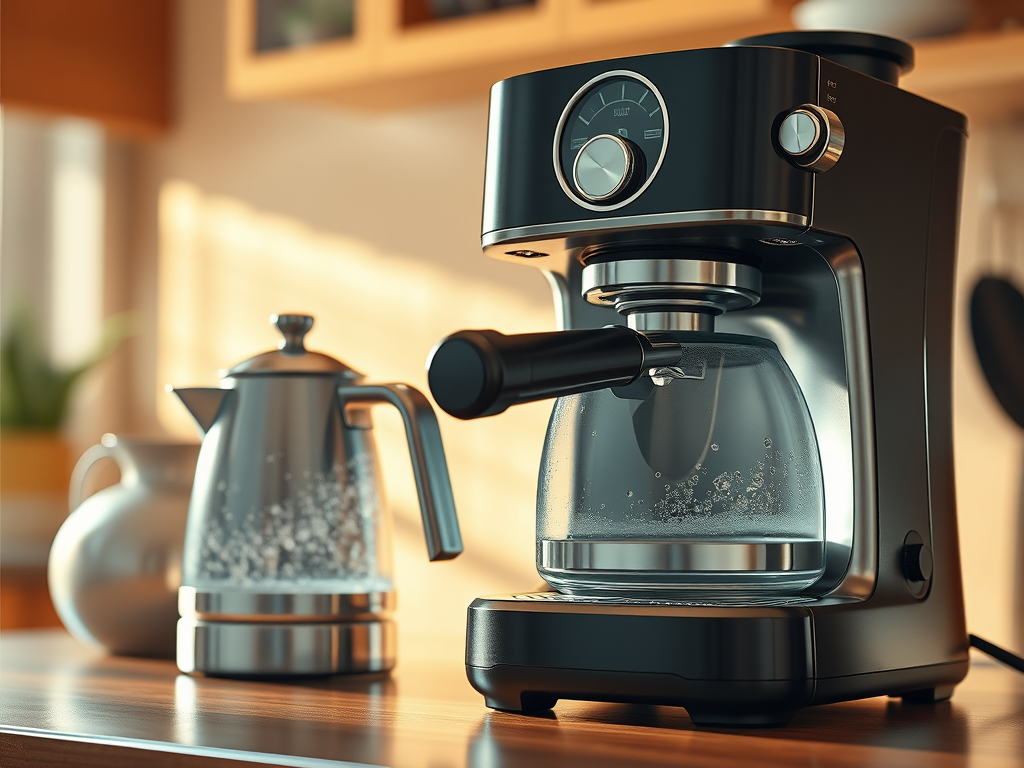
If your kettle takes forever to boil, your coffee tastes “off” for no obvious reason, or your machine suddenly starts acting possessed, there’s a boring villain behind it all: minerals.
Specifically, the minerals dissolved in water that turn into scale when heated.
The good news is you do not need a complicated routine or a chemistry degree.
You just need a simple plan you can actually follow.
What’s actually happening inside your kettle or coffee machine
Most tap and many filtered waters still contain dissolved minerals, mainly calcium and magnesium.
When water gets heated (especially repeatedly), some of those minerals fall out of solution and stick to hot surfaces.
That chalky crust is scale.
In a kettle, scale builds on the heating element and the bottom of the chamber.
In coffee machines, it collects in the boiler/thermoblock, lines, valves, and anywhere heat and flow meet.
You do not always see it, but the machine feels it.
Why minerals shorten appliance lifespan
1) Scale acts like insulation
Heating elements are designed to transfer heat into water efficiently.
Scale creates a barrier, so the element has to work harder and run hotter to do the same job.
That extra stress can shorten the life of the element and related components.
2) Scale narrows pathways and messes with flow
Coffee machines rely on consistent flow through tiny internal passages.
Scale reduces internal diameter, increases pressure, and can trigger inconsistent brewing, weak steam, sputtering, and random error codes.
3) Scale creates flavor and performance chaos
Beyond breakdowns, scale changes how heat behaves.
That can mean inconsistent temperatures, longer heat-up times, and a drift away from the coffee you bought the machine to make in the first place.
The simplest prevention plan that actually works
Step 1: Choose water that does not leave minerals behind
The most straightforward way to prevent scale is to stop feeding your machine the ingredients that make scale.
If your water has minerals, you will eventually get mineral buildup.
If your water has effectively none, the scale problem basically disappears.
That’s why distilled water is such a clean upgrade for kettles and coffee machines.
It removes the mineral variable entirely and makes the whole system easier to maintain.
If you want a simple switch that helps your appliances run cleaner for longer, start here:
shop Distilled Fulfilled distilled water in glass.
Step 2: Reset what’s already there (a quick descaling rhythm)
If your machine has been on mineral-heavy water for a while, it may already have scale buildup.
A reset helps you start fresh.
Use the descaling approach recommended by your manufacturer (some brands require a specific product).
- Kettles: If you see white chalky buildup, descale sooner rather than later.
- Drip coffee makers: Descale on a regular cadence if you are using mineralized water.
- Espresso machines: Follow your brand’s guidance carefully. Some machines want scheduled descaling; others emphasize water choice and filtration.
Once you switch to low-mineral water, you can usually extend the time between deep clean cycles because you are not constantly rebuilding scale from scratch.
Step 3: Do the two “lazy maintenance” habits
- Empty standing water: Do not let water sit heated and cool repeatedly inside the machine if you can avoid it.
- Rinse removable parts: Carafes, kettle lids, and baskets collect residue faster than you think.
How to tell minerals are already costing you
- White flakes or chalky dust inside the kettle
- Longer time to boil or heat up
- Weaker steam or sputtering on espresso machines
- More noise than usual during heating
- Coffee that suddenly tastes flatter or harsher
- “Clean me” or descaling lights showing up constantly
If you are seeing two or more of these, it is usually not “the machine getting old.”
It is minerals doing what minerals do.
The small upgrade that saves big headaches
Most people treat kettles and coffee machines like they are disposable.
But a lot of early failures are not mysterious defects.
They are mineral buildup, accumulated over time, quietly forcing components to run hotter, work harder, and clog tighter.
The simplest prevention plan is also the easiest one to maintain:
use water that does not create scale, then descale only as needed, not as a constant fight.
If you want to make that switch today, start here:
Distilled Fulfilled distilled water in glass.
Leave a Reply