
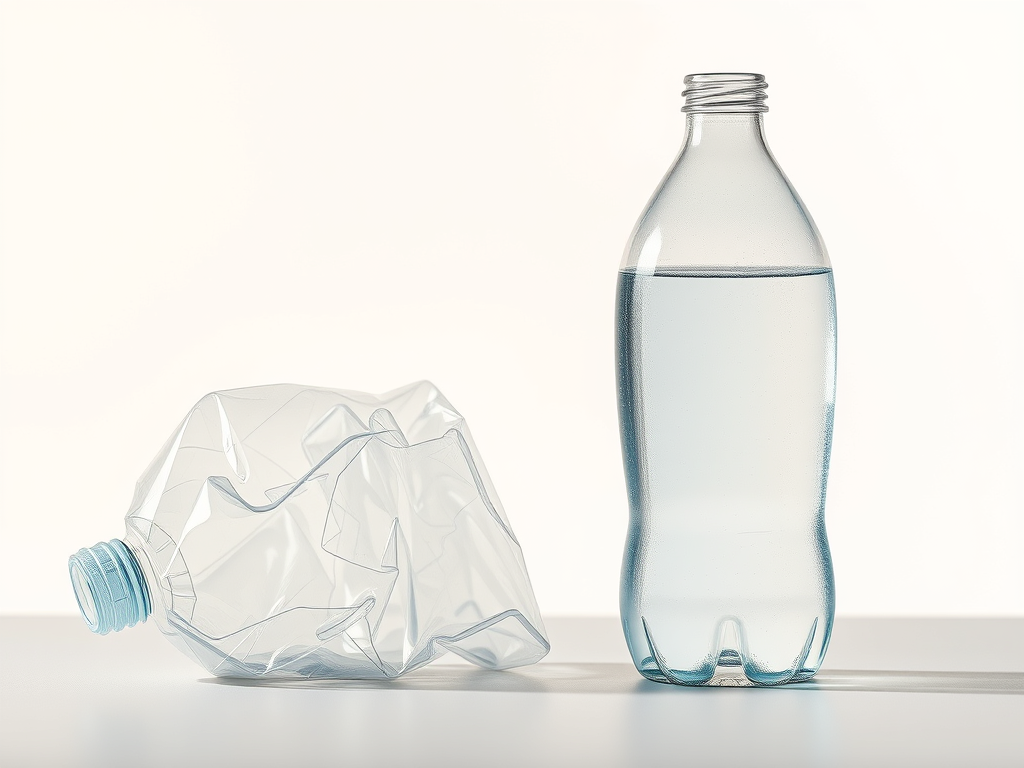
If you care about what touches your water, what ends up in landfills, and what quietly ends up in your body, glass vs. plastic is not a lifestyle debate. It is a materials reality.
The Short Version
- Glass is inert. It does not shed, leach, or “season” your water with extra chemistry.
- Plastic is not inert. It can shed microplastics and can leach compounds, especially with heat, time, and repeated handling.
- Glass supports reuse. Plastic is engineered for disposability, even when it pretends otherwise.
What “Inert” Actually Means (And Why It Matters)
Glass is essentially a stable barrier. In real-world use, it is one of the few packaging materials that does not behave like a slow exchange program between container and contents. Your water stays water.
Plastic, by design, is a flexible polymer system. That flexibility comes with tradeoffs. Plastic can shed tiny particles and can interact with what it holds. You do not need a dramatic headline to understand the core point: plastic is not a neutral container.
Microplastics: The Problem You Cannot “Opt Out” Of
Microplastics are not a marketing buzzword. They are a physical reality of plastic wear, friction, and breakdown. Plastic bottles can contribute to microplastic exposure through shedding and degradation across the product lifecycle.
That matters because water is a daily, high-frequency habit. If you do something multiple times a day, every day, the container choice is not minor. It is cumulative.
Glass does not have a “microglass” shedding problem in everyday bottled water use. It does not flake into your drink the way plastics can fragment.
Plastic Waste: The System Is Working Exactly As Designed
Plastic bottles are a volume business. They are produced at scale, distributed at scale, and discarded at scale. The entire system relies on you throwing them away. Even when plastic is labeled “recyclable,” the real-world outcome is ugly:
- Low effective recycling rates. Many plastic bottles do not become bottles again. A lot becomes lower-grade material, or becomes trash.
- Contamination and sorting failures. Recycling depends on perfect behavior and perfect infrastructure. Plastic waste depends on neither.
- Persistence. Plastic does not harmlessly disappear. It breaks into smaller pieces and spreads.
- Waste management burden. Plastic shifts the cost and mess to municipalities, landfills, waterways, and future cleanup.
Plastic’s “lightweight convenience” is not a feature if it translates into more units produced, more units discarded, and more units escaping into the environment.
Glass Is Built for Reuse (Plastic Is Built for the Trash)
Glass wins where it counts: durability of purpose. A glass bottle is meant to be used again and again. It is easy to clean, does not hold odors, and does not slowly degrade into a fuzzy, scratched container that you stop trusting.
Plastic bottles, on the other hand, have a short life by default. Scratches, clouding, warping, and “that smell” are not rare. They are normal. Plastic teaches you to replace. Glass supports a culture of reuse.
Let’s Talk About the “Negatives” of Glass (And Why They Do Not Beat Plastic’s Negatives)
1) “Glass is heavier”
Yes, glass weighs more. But weight is a logistics issue, not a health issue. It is solvable with smarter routing, local delivery, and reuse systems. Plastic’s downsides are not “solve it with better logistics.” Plastic’s downsides are “this material sheds and becomes waste forever.”
2) “Glass breaks”
Breakage is visible and manageable. You handle glass carefully, store it sensibly, and use protective packaging where needed. That is not a flaw. That is accountability. Plastic’s damage is often invisible and distributed, meaning it can do harm quietly: particles, chemical leaching, and widespread litter that becomes everyone’s problem.
3) “Glass takes energy to make”
Single-use comparisons are the wrong frame. Glass is not supposed to be a one-and-done container. The advantage of glass is its ability to be reused without turning into a chemistry experiment or a degraded mess. The more it is reused, the more its sustainability advantage compounds. Plastic relies on constant replacement and constant disposal.
The Taste and Trust Factor
Plastic can impart flavors and odors. It can make water taste “off” even when the water itself is clean. Glass does not do that. Glass keeps the experience consistent. More importantly, glass keeps the relationship simple: you do not have to wonder what your bottle is adding to the conversation.
If You Want “Cleaner,” Plastic Is the Wrong Container
People love to debate water: purity, minerals, filtration, taste. Then they put it in a container that can shed particles, absorb odors, and turn into landfill confetti. That is backwards.
If your goal is cleaner water and a cleaner footprint, glass is the adult choice.
Make the Switch
You do not need perfect habits. You need one better default.
Choose glass. Avoid plastic. Reduce microplastic exposure. Reduce disposable waste.
Ready to make it easy?
Shop Distilled Fulfilled glass-bottled water here.
Leave a Reply